
What Does MRO Mean in Manufacturing?
In manufacturing environments, most attention is placed on production output, throughput, and finished goods. What often receives less visibility is the system that keeps equipment running safely and reliably every day. That system is MRO.
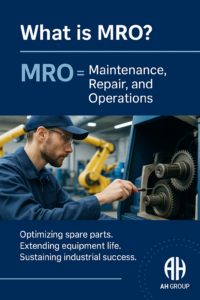
MRO stands for Maintenance, Repair, and Operations. In manufacturing, MRO refers to the activities, processes, and materials required to maintain equipment, repair failures, and support daily facility operations. While MRO does not directly contribute to finished products, it plays a critical role in uptime, safety, and overall operational efficiency.
At AH Group, we work with manufacturers across industries to strengthen MRO strategies, reduce downtime, and improve repair and asset reliability through trusted industrial repair and supply chain support.
What Does MRO Actually Mean in Manufacturing?
The meaning of MRO in manufacturing can be understood in two common ways:
-
Maintenance, Repair, and Operations: The most widely used definition in manufacturing, covering routine maintenance, corrective repairs, and the supplies needed to keep facilities operational.
-
Maintenance, Repair, and Overhaul: A term more commonly used in industries such as aerospace and defense, where equipment undergoes scheduled teardown, inspection, and refurbishment.
In manufacturing, MRO generally refers to indirect goods and services. These are items that do not become part of the finished product but are essential for production continuity. This is what separates MRO spend from direct materials like raw inputs or components.
A well-managed MRO program helps manufacturers improve reliability, reduce unexpected failures, and control operating costs.
What Is Included in MRO?
MRO covers a broad range of materials, equipment, and services used throughout a manufacturing facility. Common MRO categories include:
-
Spare parts and components such as motors, bearings, seals, pumps, gearboxes, and lubricants
-
Preventive maintenance supplies including belts, filters, sensors, and consumables
-
Facility and janitorial supplies like industrial cleaners, lighting, HVAC components, and building maintenance materials
-
Safety equipment and PPE such as gloves, respirators, hard hats, eyewear, and lockout devices
-
Material handling and support equipment including conveyors, forklifts, and storage systems
-
Office and general plant supplies that support daily operations
Beyond materials, MRO also supports different maintenance approaches used in manufacturing environments.
MRO and Maintenance Strategies
MRO plays a role across several core maintenance strategies:
-
Preventive maintenance, which focuses on routine servicing to avoid breakdowns
-
Predictive maintenance, which uses data and condition monitoring to anticipate failures
-
Corrective maintenance, which addresses repairs after a failure has occurred
An effective MRO program aligns inventory, repair services, and maintenance planning to support these strategies without excessive downtime or excess inventory.
Common Challenges in MRO Management
Despite its importance, MRO is frequently under-optimized in manufacturing organizations. Common challenges include:
-
Fragmented or decentralized purchasing across departments
-
Poor visibility into spare parts inventory and usage
-
Overstocking of low-use items while critical parts remain unavailable
-
Reactive repair approaches that increase downtime and costs
-
Limited insight into total cost of ownership for parts and repairs
These issues often lead to higher operating costs, longer equipment outages, and lost productivity for maintenance teams.
Improving MRO Performance in Manufacturing
Modern manufacturers are increasingly treating MRO as a strategic function rather than a necessary expense. Effective MRO improvement often includes:
-
Centralized sourcing and standardized suppliers
-
Vendor-managed inventory programs to reduce stockouts and excess inventory
-
Integration with CMMS or EAM systems for maintenance planning and asset tracking
-
Data-driven repair decisions based on failure history and equipment criticality
-
Reliable repair partners that can extend asset life and reduce replacement costs
AH Group supports manufacturers by simplifying MRO repair management, coordinating complex repairs, and providing access to a global network of qualified repair partners.
Why MRO Matters More Than Ever
MRO directly impacts manufacturing uptime, worker safety, and operational resilience. As equipment becomes more complex and supply chains remain under pressure, having a reliable MRO strategy is no longer optional.
When managed effectively, MRO helps manufacturers reduce downtime, control indirect spend, and maximize the value of existing assets.
How AH Group Can Help
AH Group helps manufacturers turn MRO into a competitive advantage. From managing complex industrial repairs to supporting smarter MRO sourcing strategies, our team helps reduce downtime and improve reliability across operations.
Contact AH Group today to learn how we can support your MRO repair and maintenance strategy and keep your operation running at its best.